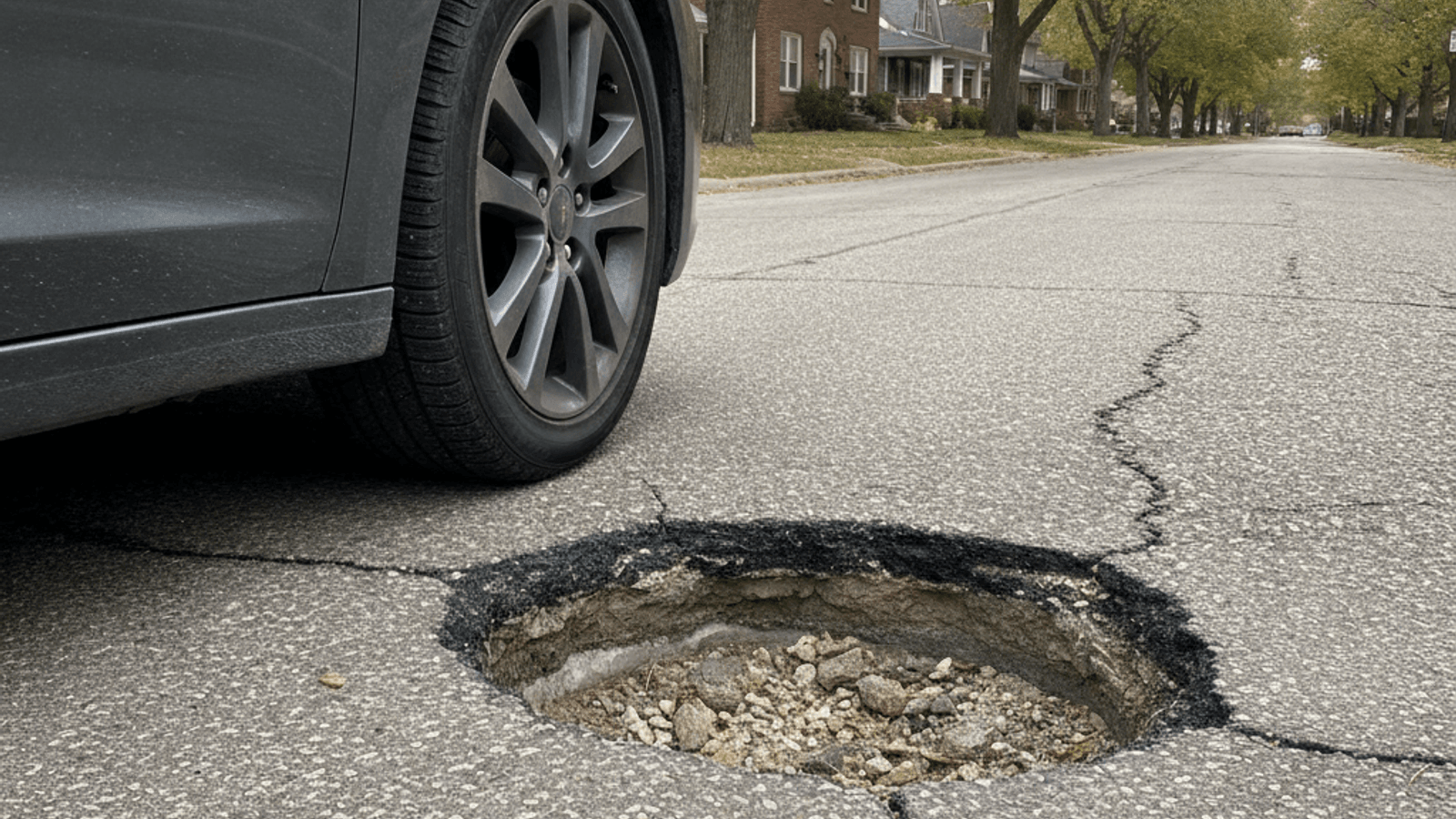
Why Kansas pothole season is worse than a normal winter aftermath
Every cold-climate state deals with potholes after winter, but the specific freeze-thaw pattern Topeka goes through makes it worse than a steady cold winter would. Water gets into small cracks in the pavement, freezes and expands, then thaws again when temperatures climb back above freezing, sometimes repeatedly within the same week during a Kansas winter. Each cycle widens the crack a little more, and by the time spring arrives, that repeated freeze-thaw has turned small pavement flaws into the kind of deep, sharp-edged potholes that can knock a car’s alignment out in a single hard hit.
That’s why spring is consistently the season when alignment-related complaints spike. It’s not a coincidence or a seasonal sales push. It’s a direct, physical consequence of what a Kansas winter does to pavement, especially on well-traveled routes like the Wanamaker corridor and other heavy commuter roads that see constant stress on top of the freeze-thaw damage.
The three signs that actually point to an alignment problem
A lot of driving symptoms can overlap, which makes it easy to guess wrong about what’s actually causing a problem. Three signs specifically point toward alignment rather than something else.
Pulling on a flat, straight road is the clearest one. If you have to consistently hold slight pressure on the steering wheel to keep the car going straight, and the road itself is flat with no crown pulling you one direction, that’s a strong alignment signal. It’s worth ruling out an obviously low tire first, since uneven tire pressure can mimic a pull, but if pressures are even and the pull persists, alignment is the likely cause.
A crooked steering wheel while driving straight is the second sign, and it’s one people adapt to without realizing it. If your steering wheel sits noticeably off-center, rotated a few degrees to one side, while the car is actually traveling straight, that’s a visible symptom of alignment being out, not a coincidence or a “that’s just how this car is” situation.
Uneven tire wear, especially concentrated on the inside or outside edge of one or more tires rather than spread evenly across the tread, is the third sign, and it’s often the one that goes unnoticed longest because it develops gradually. Running a hand across the tread, feeling for one edge that’s noticeably more worn than the other, is a quick check worth doing periodically, not just after you already suspect a problem.
What actually happens during a proper alignment check
A real wheel alignment uses computerized measurement equipment to check camber, caster, and toe, the three angles that determine how a wheel sits relative to the road and the rest of the car, against the manufacturer’s exact specifications for your vehicle. That’s meaningfully different from an eyeball adjustment, and it’s the only way to know precisely how far out of spec a car actually is rather than guessing from symptoms alone.
A thorough shop also checks for worn suspension components before making the adjustment, since a control arm bushing or tie rod end with excess play can throw off an alignment almost immediately after it’s corrected, wasting the money spent on the adjustment itself. This is where alignment work connects directly to suspension and steering inspection; fixing alignment without addressing a worn component underneath it is treating the symptom instead of the cause.
What happens if you keep driving on bad alignment
Ignoring alignment symptoms doesn’t just mean living with a slight pull. Misalignment accelerates tire wear meaningfully, sometimes shortening tire life by thousands of miles compared to a properly aligned car, which turns a roughly $80 to $150 alignment into an unnecessary early tire replacement that costs several times more. It also affects handling and stability, which matters more during wet or icy conditions than it does on a dry summer day, since a car that’s already pulling or wandering slightly has less margin for error when traction is already reduced.
Timing an alignment check around new tires
If you’re about to buy new tires after a rough winter of pothole impacts, getting an alignment check at the same time, or right before, is a genuinely reasonable step rather than an upsell. Putting brand-new tires on a car with an alignment that’s been quietly off since a January pothole hit means those new tires start wearing unevenly from day one, undoing a good chunk of the value of replacing them in the first place.
When to check, even without obvious symptoms
Beyond the three clear symptoms, it’s reasonable to have alignment checked any time you know you hit a significant pothole or curb hard, even if nothing feels obviously wrong afterward. Some alignment issues are subtle enough that they don’t produce a noticeable pull or crooked wheel right away, but they’re still quietly wearing tires unevenly in the background.
How alignment problems connect to brakes and steering feel
A car that’s out of alignment doesn’t just wear tires unevenly, it can also change how braking feels. A slight pull under braking that wasn’t there before, separate from any noise, is sometimes an alignment symptom rather than a brake problem on its own, and it’s worth mentioning both when you bring the car in so a shop can check brake repair concerns and alignment together rather than treating them as unrelated. Steering feel changes in a similar way. A car that used to feel tight and precise but now feels slightly vague or requires more correction to hold a line is often showing early alignment wear before it becomes an obvious pull.
What a fair alignment estimate should include
A standard four-wheel alignment reasonably runs $80 to $150, and a fair estimate should state upfront whether that price assumes no additional repairs are needed. If a shop discovers a worn tie rod or control arm bushing during the alignment check, that’s a separate repair with its own cost, and a written estimate should treat it as a distinct line item rather than folding it into a vague, higher total. Kansas consumer protection guidance backs your right to that clarity before any additional work beyond the alignment itself gets authorized.
Don’t wait until the next hard winter to check again
Alignment isn’t a fix-it-once-and-forget-it item in a region with an annual freeze-thaw cycle this active. A car that’s driven correctly last spring can still end up out of alignment again after this year’s pothole season, especially if it regularly travels heavily traveled routes like the Wanamaker corridor where road stress compounds year over year. Treating a spring alignment check as a yearly habit, alongside routine tire rotation, is a more realistic approach here than assuming one correction lasts indefinitely.
How do I know if my car needs an alignment after hitting a pothole?
Watch for pulling on a flat road, a steering wheel that sits crooked while driving straight, or tire wear concentrated on one edge. Any one of these on its own is worth getting checked, and if you know you hit a significant pothole hard, it’s reasonable to get an alignment check even without obvious symptoms yet.
Why does Kansas seem to have worse potholes than other places after winter?
The repeated freeze-thaw cycle Topeka goes through, water getting into pavement cracks, freezing and expanding, then thawing again, sometimes multiple times in the same week, does more damage to pavement than a steady cold winter would. That repeated cycle is what turns small cracks into the deep, sharp-edged potholes that show up every spring.
Can bad alignment really shorten the life of new tires that much?
Yes, meaningfully. Driving on a misaligned car wears tires unevenly and can shorten their usable life by thousands of miles compared to a properly aligned vehicle. Getting an alignment check before or right after installing new tires protects that investment.
Is it worth getting an alignment even if I don’t feel a pull yet?
Yes, if you know you hit a significant pothole or curb hard. Some alignment issues develop subtly enough that they don’t produce an obvious pull right away but are still causing uneven tire wear in the background. A quick check after a hard impact catches that before it costs you a set of tires.
If pothole season left your car pulling, your wheel sitting crooked, or your tires wearing unevenly, it’s worth getting checked before it costs you a set of tires. Topeka Auto Pro connects Greater Topeka drivers with local shops that measure alignment properly instead of eyeballing it. Call (785) 000-0000 and we’ll point you toward one.