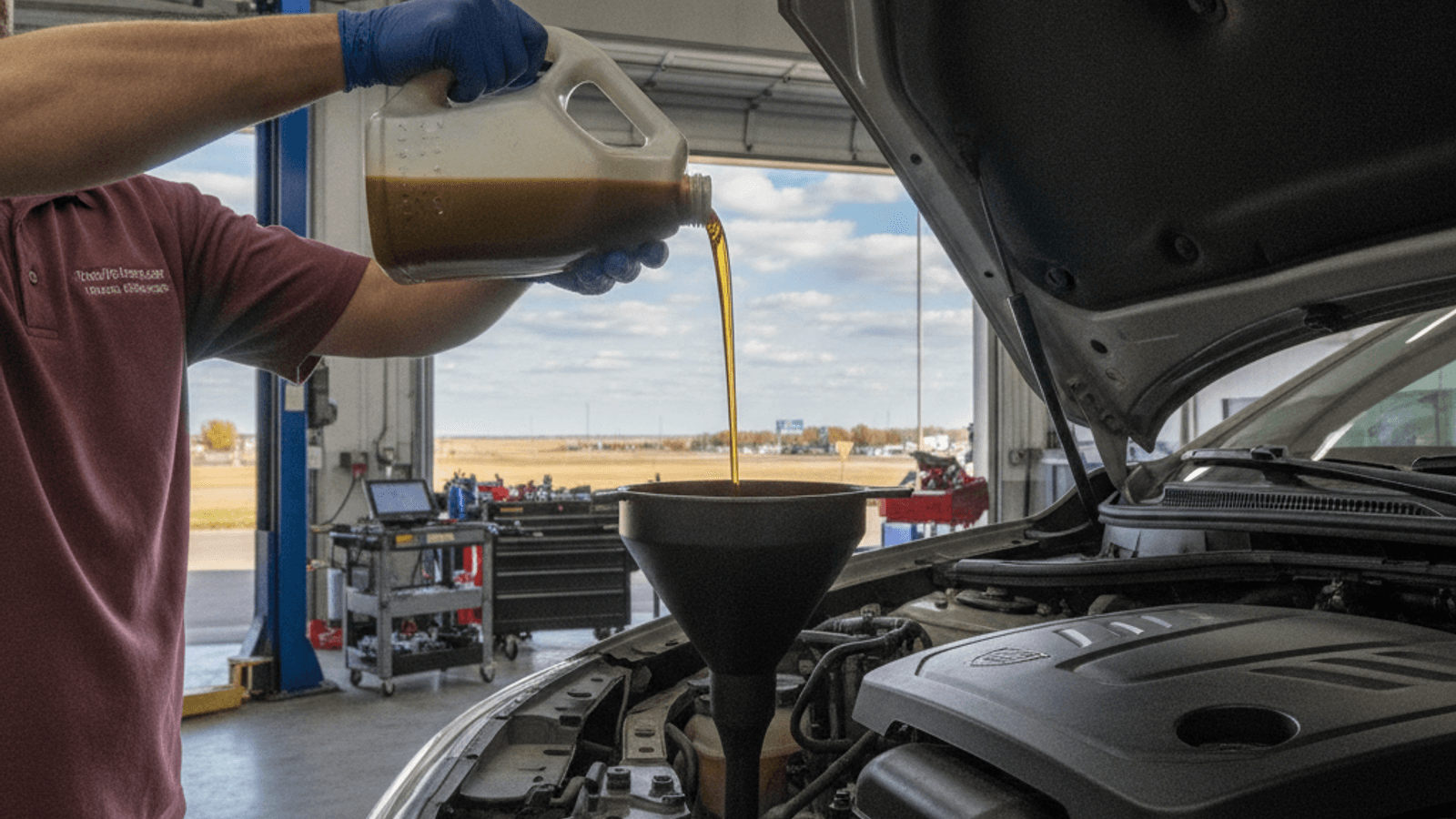
Where the 3,000-mile number actually came from
Every driver over 35 grew up hearing it: change your oil every 3,000 miles, no exceptions. It’s printed on the sticker some quick-lube shops still slap on your windshield. It’s also mostly wrong for a car built in the last 15 years.
The 3,000-mile interval comes from an era of conventional oil and engine tolerances that don’t match modern vehicles. Today’s engines run tighter clearances, use better oil formulations, and in most cases specify intervals of 5,000 to 7,500 miles on full-synthetic oil, sometimes further out than that. Sticking to 3,000 miles on a car that doesn’t need it isn’t dangerous, but it’s money spent on oil changes you don’t need, four or five times a year instead of two or three.
The real number is sitting in your glovebox. Your owner’s manual lists the manufacturer’s interval for your specific engine and oil type, and that’s the number that actually applies to your car, not a sticker or a rule of thumb.
Why Kansas driving can shorten that number anyway
Manufacturer intervals assume a mix of driving conditions, and a lot of drivers here fall outside that mix without realizing it. Short trips matter more than most people expect. An engine needs several miles of driving to reach full operating temperature, and oil does its best job of burning off moisture and combustion byproducts once it’s hot. A commute that’s mostly short hops around Central Topeka, dropping kids off, running errands, never getting the engine fully warmed up, puts more strain on oil per mile than a longer highway stretch on I-70 does.
Cold starts add to that. A Topeka winter morning with the engine sitting at 15 or 20 degrees overnight means the oil is thick and slow to circulate for the first several minutes of driving, which is exactly when an engine sees the most wear. Manufacturers that publish two intervals, a “normal” schedule and a “severe” schedule, usually put frequent short trips and extreme cold starts on the severe list. If most of your driving looks like that, the shorter interval on your maintenance schedule is the one that applies to you, not the longer one.
Drivers doing regular highway miles on US-75 or out toward Osage City and Lyndon on longer, steadier drives are closer to the manufacturer’s “normal” assumption and can often stick to the longer interval without issue.
Full-synthetic versus conventional, and whether it’s worth it
Full-synthetic oil holds up better across temperature extremes than conventional oil does, and Topeka’s range from below-zero cold snaps to 90-plus degree summer highway driving is a real stress test. Synthetic oil resists breaking down at high temperatures and flows better at low temperatures, both of which matter here more than in a climate with a narrower seasonal swing.
It costs more per change, typically landing in the $70 to $90 range compared to $40 to $60 for a conventional change, but it usually extends the interval enough that the annual cost difference is smaller than the per-visit price suggests. Most newer vehicles specify synthetic or a synthetic blend anyway, so the choice has often already been made by the manufacturer rather than left up to the driver.
What a shop should actually check during a routine oil change
An oil change is one of the few times a car is already up on a lift for a reason that has nothing to do with a suspected problem, which makes it the cheapest moment to catch something small before it becomes expensive. A shop doing this right isn’t just draining and refilling. It’s checking tire tread and pressure, looking at belts and hoses for cracking, topping off coolant and washer fluid, and flagging anything that looks close to needing attention.
That’s part of why scheduled maintenance built around your actual owner’s manual intervals tends to save money over time compared to reactive repairs. Skipping the walk-around inspection that comes with a proper oil change means those small issues, a belt starting to crack, a tire wearing unevenly, don’t get caught until they’re bigger problems. If your check-engine light has come on around the same time you’re due for an oil change, it’s worth getting both looked at together rather than treating them as separate visits; a shop offering engine diagnostics can usually fold that into the same appointment.
What buying a used car changes about the math
If you just bought a used car with no service history, the safest move is treating the first oil change as due immediately rather than guessing at when the previous owner last had it done. Dark, gritty oil on the dipstick is a decent visual clue that it’s overdue, but you can’t always tell from a quick look whether the interval has been stretched repeatedly. A fresh oil change alongside a broader inspection is a reasonable way to start a new-to-you car off on the right foot, especially if you’re not sure what kind of driving it saw before you owned it.
What actually happens if you stretch the interval too far
Pushing an oil change well past its interval isn’t an immediate disaster, but the effects compound in ways that are easy to underestimate. Oil gradually loses its ability to lubricate and carry heat away from moving parts as it breaks down, and once it’s badly degraded, it stops protecting against friction the way fresh oil does. Sludge, a thick residue that forms from oxidized oil and combustion byproducts, can build up in places that are expensive to clean out later, sometimes clogging small oil passages that starve parts of lubrication. None of this shows up overnight, which is exactly why it’s easy to keep pushing an overdue interval without noticing a problem until the damage is already done.
The honest middle ground is this: going a few hundred miles past your interval because life got busy isn’t going to hurt anything. Going thousands of miles past it repeatedly, especially combined with the short-trip, cold-start driving common around Topeka in winter, is a different story, and it’s the kind of wear that tends to show up as an expensive repair years down the road rather than a sudden breakdown.
Small-town shops and the reality outside Topeka proper
Drivers out toward Holton, Osage City, or St. Marys often don’t have a big-box quick-lube option nearby, and that’s genuinely fine. A Main Street independent shop in a smaller Jackson or Osage County town can do a proper oil change just as well as a chain location in Topeka, and they’re frequently the only realistic option for a real radius of rural county roads anyway. What matters is the same regardless of shop size: the right oil weight and type for your specific engine, a filter change every time, and a quick check of the basics while the car’s already up.
Is the 3,000-mile oil change rule ever still correct?
For most modern engines on synthetic or synthetic-blend oil, no. It’s closer to correct for an older vehicle still running conventional oil, or for a car doing almost entirely severe-duty driving like constant towing or extremely short trips. Your owner’s manual interval, not a generic rule, is the number to follow.
How do cold Kansas mornings actually affect my engine oil?
Cold oil is thicker and slower to circulate, so the first several minutes after a cold start put more wear on engine components than driving once everything is up to temperature. Frequent short trips in winter, where the engine never fully warms up, compound that effect and are one of the main reasons manufacturers list a shorter “severe duty” interval.
Does it matter which shop does my oil change if I want it done right?
It matters more than people expect. A quick oil-only swap without checking fluid levels, tires, and belts skips the part of the visit that catches small problems early. Ask what gets inspected during the visit, not just whether the oil gets changed.
Should I switch to full-synthetic oil if my car came with conventional?
Check your owner’s manual first, since some engines aren’t designed for synthetic oil’s different flow characteristics. If your manual allows it, switching generally extends your interval and holds up better across a Kansas summer-to-winter temperature swing, which can offset the higher per-change cost.
Figuring out the right interval for your actual car and your actual driving is worth a five-minute conversation with a shop that will look at your manual instead of guessing. Topeka Auto Pro connects Greater Topeka drivers with local shops that check your owner’s manual schedule and your driving pattern before recommending anything. Call (785) 000-0000 and we’ll get you pointed to one nearby.